UAV Composite Crash & Drone Engineering using LS-DYNA

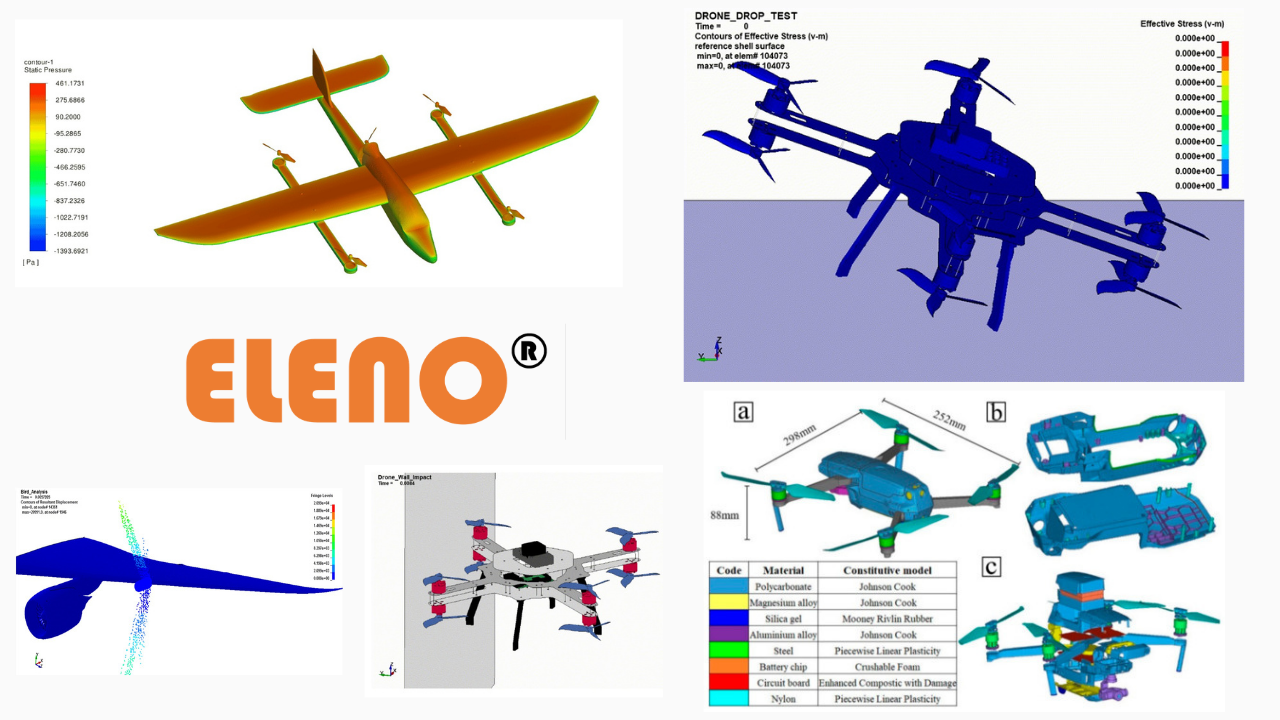
Simulate real drone crash, understand composite failure, and design safer UAV structures used in defense and aerospace industries.
By Nachiket Phadke
20+ years of experience in CAE
Founder – ELENO
asset
calendar_today
Starts on
April 4th
access_time
Time
8 to 10 PM
asset
view_day


2 Day Workshop
Enrollment ends soon. Claim your spot!
00
days
00
hours
00
minutes
00
seconds
Register Today

WHAT YOU WILL LEARN

done

How drones fail during crash & landing

done

Basics of composite material behavior

done

LS-DYNA crash simulation workflow

done

Energy absorption & damage interpretation

done

Design improvements for safer UAV structures

WORKSHOP HIGHLIGHTS

mobile_friendly

Real Drone Arm Impact Case Study

lightbulb

Pre-built Model (No confusion)

data_thresholding

Live Simulation Demonstration

perm_media

Damage Visualization & Failure Understanding

business_center

Engineering-Based Design Improvements

WHO THIS IS FOR

engineering

Mechanical Engineering Students

airplanemode_active

Aerospace Engineering Students

electric_car

EV & Automotive Engineers

person_search

CAE Beginners (LS-DYNA / HyperMesh)

rocket_launch

Engineers aiming for Defense & Aerospace careers

Workshop Structure

expand_more

Chapter 1: UAV Crash Physics & Fundamentals

This chapter introduces the fundamentals of UAV crash behavior, including how drones fail during impact, load cases, and energy transfer during landing and crash scenarios.
expand_more

Chapter 2: Composite Modeling Basics

Learn the basics of composite materials, laminate stacking, and how composite structures behave differently from metals in impact conditions.
expand_more

Chapter 3: LS-DYNA Simulation Setup

Understand how to set up a crash simulation in LS-DYNA, including material models, contact definitions, and boundary conditions.
expand_more

Chapter 4: Drone Drop Simulation Execution

Perform a real drone arm drop simulation, including defining drop conditions, running the model, and observing initial results.
expand_more

Chapter 5: Progressive Failure & Damage Analysis

Explore how composite materials fail, including fiber and matrix damage, and learn how to interpret failure contours and results.
expand_more

Chapter 6: Energy Interpretation & Engineering Insights

Understand internal vs kinetic energy, energy absorption, and how engineers analyze simulation results to make design decisions.
expand_more

Chapter 7: Battery Protection & Design Improvement

Learn how to improve drone safety by modifying laminate stacking, adding cushioning, and redesigning structures to reduce damage.

expand_more

Chapter 8: Redesign Simulation & Final Insights

Apply design changes, re-run simulations, and compare results to understand how engineering improvements impact performance.

asset

Instructed by
 Mr. Nachiket Phadke

check_circle
Industry insights from 20+ years of CAE experience
check_circle
Learn real applications of EV simulation engineering
check_circle
Understand how CAE engineers work in automotive companies
check_circle
Career guidance for Mechanical & Automotive engineers
check_circle
Introduction to tools used in EV product development
Register Workshop

ABOUT ELENO 

ELENO Engineering Learning Center is dedicated to developing industry-ready CAE simulation engineers. Our programs focus on practical, hands-on learning that reflects how simulation is actually used in real engineering environments.

Engineers at ELENO gain experience through industry-oriented CAE training, real engineering simulation projects, and mentorship from experienced professionals. Along with technical learning, we also provide career guidance and placement support to help engineers transition into high-demand roles.

Our mission is to help engineers build successful careers in Automotive Engineering, Electric Vehicle Development, CAE Simulation, Aerospace, and Defense industries.

asset
Copyright © 2026 ELENO-ELE. All Rights Reserved.